
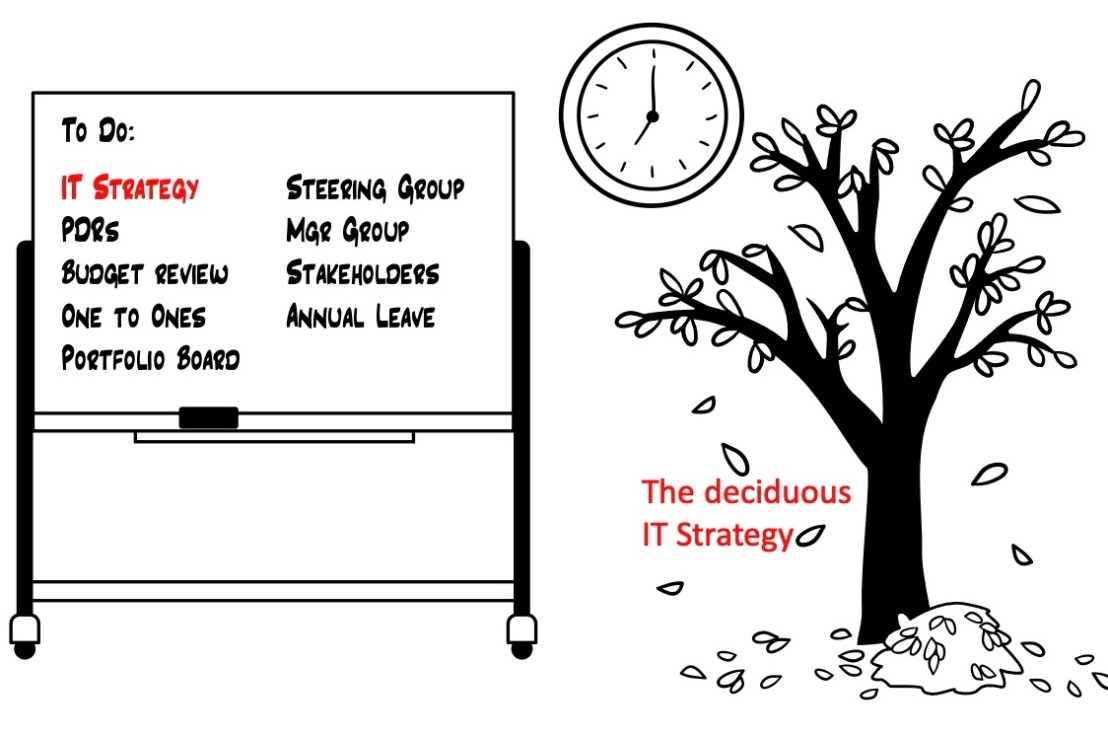
The IT strategy takes time to write and yet may have to fit into the corners of the day job. Yet the pace of change is increasing and even an annual update of the IT strategy seems too slow. How can we possibly make the strategy evergreen?
Why go evergreen?
Evergreen is a growing strategy around IT though not always defined in those terms. The services and products that IT is deploying are moving to an evergreen model or more commonly called a service model. Our infrastructure is becoming code on the cloud. Our operating systems now run rolling patches. Our applications are becoming software as a service. The regular upgrade projects or migrations projects have become rare though I am not going to say becoming extinct. IT is a constantly on service supported by constantly on services.
An agile engineering culture appears to have reduced the importance of the annual roadmap update. Even HR has recommended a continuous performance review and development cycle rather than the annual panic to get PDRs done. So what is left in the old annual cycle? Budgets are still there and unlikely to change due to the statutory requirements around financial reporting of most organisations. The budget is supported in part by the IT Strategy and the mid range plan (MRP) or financial plan. The MRP is still dependent on the roadmap and capacity plan. There is therefore clearly an annual consumption need for our IT strategy for budgeting.
The strategy is also driving change in the IT organisation and service. It is after all both a narrative of current to future state and a strategic plan to get there. Linking closely to the business strategy. The strategic plan is certainly a constantly evolving position which like every plan benefits from being continually updated to show the progress and estimated completion.
The narrative of an IT strategy demonstrates alignment to our business strategy and how IT supports the business. It is a communication and motivational asset. Where the business is evolving quickly or major transformation events occur the lack of change in the IT strategy narrative can make it feel like IT is not aligned or slow to adapt. This impacts the motivation of the IT team and may erode other divisions’ respect for IT.
Evergreen IT strategy an imperative?
Is the evergreen IT strategy an imperative? I think the answer to that is it depends on how dynamic the organisation is. Risks around a lagging strategy are around stakeholder perception and IT team motivation. How big an issue is that for your organisation?
The risks of the business strategy evolving more quickly than IT can be mitigated through good Horizon Scanning processes (see my previous blog) and event triggered process to update the strategy. Working closely with business leaders and any strategy team or innovation teams to make sure that IT leadership knows about the evolution as it is being defined. Even if this means some IT resources must be included in the NDAs.
Evergreen updates
When we say evergreen does that mean updating the whole strategy? If the strategic plan is updated as it progresses and the effective areas of the narrative updated then the strategy will be perceived to be up to date. If pieces of the strategy narrative are relayed in IT team communication events on a regular basis then the messaging remains fresh. In which case perhaps the evergreen strategy is not the heavy amount of work we first assume.
To allow a more frequent and lighter update cycle we need to make sure the strategy is modular, like we would do in an IT system to make it easily updated. This way only the areas impacted by a strategic change need to be refined. Of course the executive summary will also need reworking. In my IT Strategy course on Udemy I show how the IT Strategy can be broken down into modules that are more easily refined.
Summary
An evergreen IT strategy has clear advantages but may not be an imperative for all organisations. The perception to stakeholders and the IT team that IT is on point with the evolving organisation becomes a cultural advantage. To achieve it will require strong relationships with the business leaders and strategy team. IT will also need to modularise the IT Strategy to allow updates to be lighter initiatives.
For more on IT Strategy please see my IT Strategy course on Udemy.
If you are interested in IT Strategy, IT Architecture, IoT, or Raspberry PI, please do follow me on social media.


