
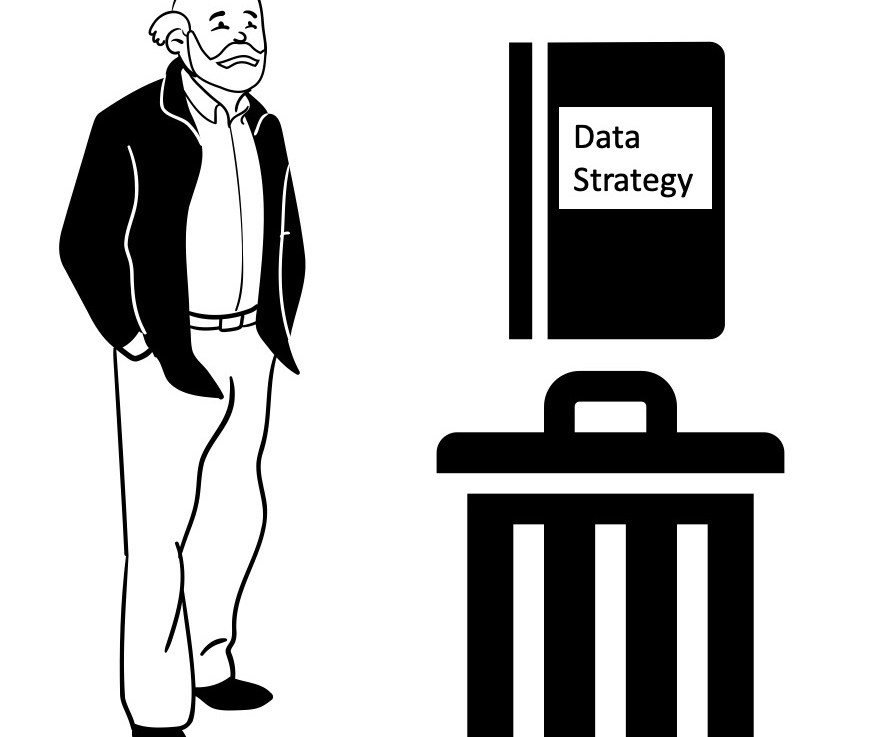
You put a lot of work into the data strategy, working all hours around the day job to get it done. Then it gets ignored or criticised. It has been a data strategy failure.
We have all seen a number of data strategy failures over the years. Some of the most common reasons behind this are scope and relationship to the business context. We cannot get it right every time but there are common issues we can avoid.
Relevant strategy for the business
The data strategy must be perceived as relevant to the business context. The recommendations and plan in the strategy logically follow the executive’s understanding of the business and their plan. In short, the data strategy must be aligned to the business strategy.
If this alignment to the business strategy is not achieved then the data strategy will be perceived as self-serving. The actions and investments it is proposing as discretionary or unnecessary. The imperative to move forward will not be there and the data strategy is politely left on the shelf.
Summarising the business context and hunting out the business strategy is not always easy. Sometimes I have heard people complain that there is no strategy for the organisation. In my career, I have never found that to be the case. Of course, often there is not a document set down documenting the strategy but that isn’t the same thing as not having a strategy.
Balancing Concerns
Data strategy is a big area and covers a number of key concerns. Some of these are more exciting than others. This excitement sometimes leads us to focus too strongly, or exclusively, on a particular data area or concern.
For me, a data strategy must consider:
- Data Analytics and Data Assets
- Data Platforms and Tools
- Data Governance and Curation
- People Organisation and Skills
Focus on only one of these does not only disenfranchise those with an interest in the other concerns but puts our future strategic plan in jeopardy. We can’t deliver new analytics without the right data platform. More data will not be useful to the company unless governed and curated. Only an organisation with skilled data citizens can take full advantage of data.
Organisational Scope
Data teams are often federated or embedded in high data value areas. This creates a bias in focus on these areas. This bias can failed to engage the whole business in the data journey. Or cause competing data strategies to emerge focused on different organisational teams.
In large federated business organisations with multiple value chains, there may be a need for a data function federation mode. This needs to be a formal federation model being clear about who has what responsibility. Too often this is informal allowing areas to be forgotten and a competing political culture. The focus is no longer on the best value for the organisation as a whole.
A data strategy should consider the full business. The areas with strong data initiatives, and the areas where data has not yet shined. Priority may well mean that some areas get less attention in the plan, but that needs to be communicated as a priority call.
Summary
A data strategy must be relevant to the business context and consider all the data concerns and the full organisation to have the best chance of being acted on. For more on building your data strategy, please look at my course on Udemy, “Getting Started on the Data Strategy”.
If you are interested in Data Strategy, IT Strategy, IT Architecture, IoT, or Raspberry PI and Pico, please do follow me on social media.
#datastrategy #data #analytics


A very lucid post Jon, have come across some of the pain points you highlight.